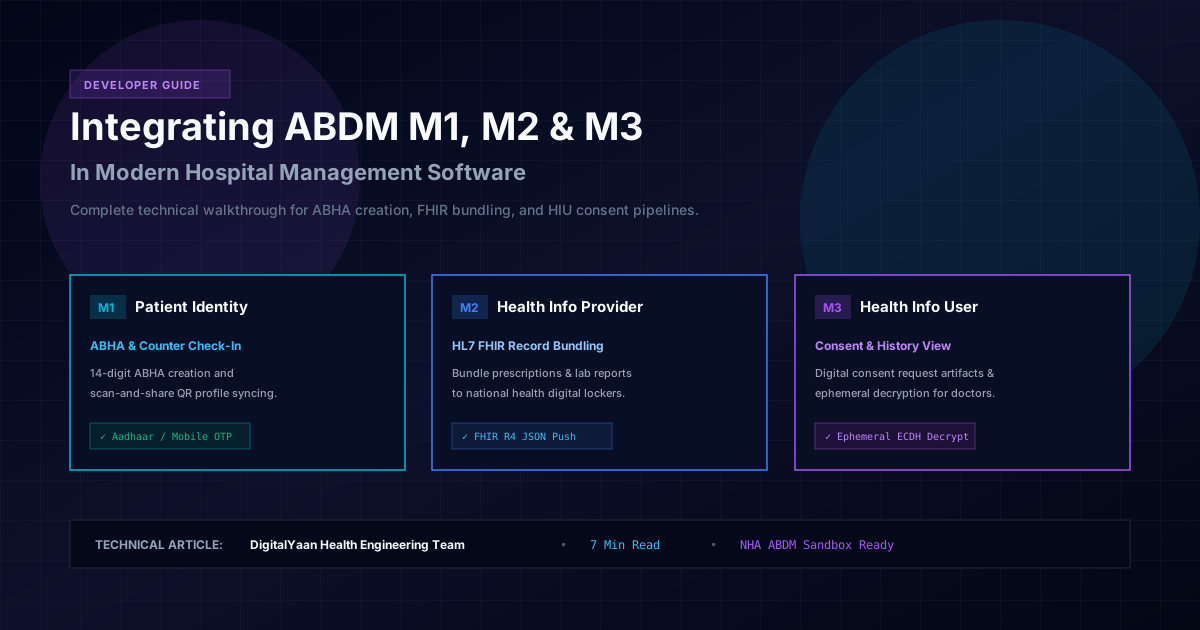
Zero-Trust Healthcare: Architecting End-to-End Cryptography for HL7 FHIR R4 Bundles
How to implement Diffie-Hellman key exchange, DPDP Act 2023 compliance, and patient digital consent boundaries in clinical software.
Safeguarding clinical health records represents both a non-negotiable statutory mandate and a foundational engineering challenge. As digital health ecosystems scale, systems architectures must seamlessly reconcile regulatory compliance—specifically India’s Digital Personal Data Protection (DPDP) Act, 2023—with zero-knowledge cryptographic safeguards that guarantee verifiable data sovereignty.
The Regulatory Landscape: DPDP Act 2023 & Data Fiduciaries
Under the DPDP Act 2023, healthcare providers, diagnostic networks, and health tech platforms are classified as Data Fiduciaries. This designation mandates uncompromising standards for clear consent lifecycles, strict purpose limitation, and auditable data processing. When transmitting longitudinal patient records and diagnostic data across distributed networks, perimeter security alone is insufficient; end-to-end cryptographic privacy must be enforced at the serialization boundary.
"Security in healthcare cannot operate as an operational afterthought; cryptographic protections and consent verification must be woven directly into data schemas and serialization pipelines."
Core Cryptographic Pillars for Health Tech Platforms
Modern platforms adopt zero-knowledge patterns to eliminate intermediary attack vectors and prevent unauthorized access by both internal operators and cloud infrastructure providers:
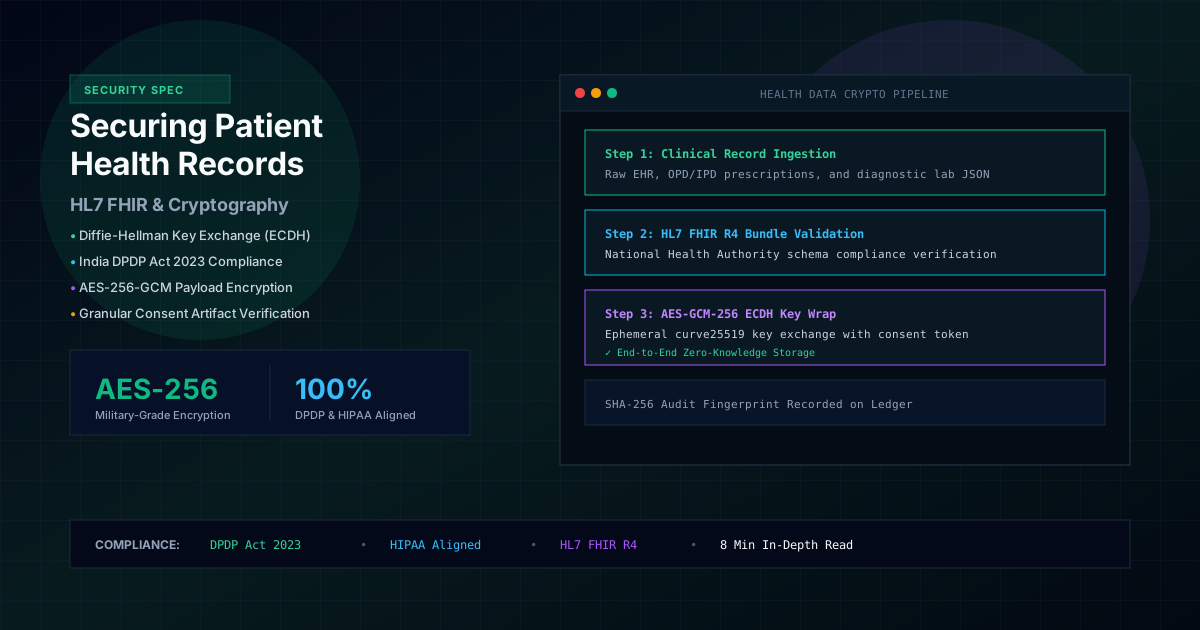
- Ephemeral Key Exchange (X25519 / ECDH): Utilizes Elliptic Curve Diffie-Hellman over Curve25519 to derive ephemeral session keys per transaction. Intermediary routers, proxy networks, and cloud orchestrators operate strictly over blind encrypted envelopes.
- Authenticated Payload Encryption (AES-256-GCM): Every HL7 FHIR (Fast Healthcare Interoperability Resources) diagnostic and clinical bundle is encrypted using AES-256 in Galois/Counter Mode (GCM), providing high-throughput confidentiality along with cryptographic integrity verification.
- Cryptographic Consent Verification: Read and write transactions execute only upon validation of a cryptographically signed consent artifact generated via the patient's Ayushman Bharat Health Account (ABHA) identity, verified against a public key infrastructure (PKI) gateway prior to decryption.
Implementation: Secure FHIR Payload Serialization
The following reference pattern demonstrates how an application layer can encrypt an outbound HL7 FHIR record using authenticated AES-256-GCM before transport persistence:
import { randomBytes, createCipheriv } from 'node:crypto';

interface EncryptedBundle {
  iv: string;
  authTag: string;
  ciphertext: string;
}

export function encryptFhirPayload(
  fhirBundle: Record<string, unknown>,
  sharedSecretKey: Buffer
): EncryptedBundle {
  // 96-bit initialization vector recommended for AES-GCM
  const iv = randomBytes(12);
  const cipher = createCipheriv('aes-256-gcm', sharedSecretKey, iv);

  const serializedData = JSON.stringify(fhirBundle);
  const encrypted = Buffer.concat([
    cipher.update(serializedData, 'utf8'),
    cipher.final()
  ]);

  return {
    iv: iv.toString('base64'),
    authTag: cipher.getAuthTag().toString('base64'),
    ciphertext: encrypted.toString('base64')
  };
}
Achieving Zero-Knowledge Compliance at Scale
Decoupling decryption keys from data persistence layers and anchoring runtime access to immutable ABHA consent artifacts enables healthcare architectures to deliver authentic zero-knowledge guarantees. This engineering approach eliminates data exposure vectors, accelerates institutional trust, and ensures absolute compliance with the evolving regulatory mandates of the DPDP Act 2023.
Senior Systems Architect with 12+ years of experience in enterprise Laravel, high-throughput cloud architectures, and ABDM healthcare interoperability.